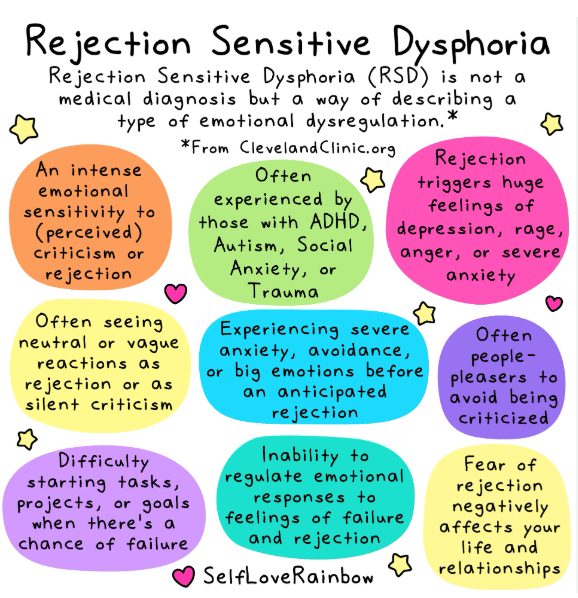

This week, we’re shining a gentle light on Rejection Sensitive Dysphoria (RSD) — what it is, how it shows up, and practical ways to soften its impact.
If you’ve ever felt an overwhelming wave of shame or sadness after a put-down, a harsh critique, or a small social stumble, you’re not alone. RSD is a name for the intense emotional pain some people experience in response to perceived rejection or disappointment.
What is RSD?
-
Rejection Sensitive Dysphoria refers to extreme emotional responses to real or perceived rejection or criticism. For some, the sting isn’t just brief—it can feel overwhelming, lingering for hours or days.
-
RSD isn’t a diagnosis in itself, but it’s a term often discussed in the context of neurodivergent experiences, particularly in relation to ADHD, autism, dyslexia, and other profiles where emotional regulation can be more challenging.
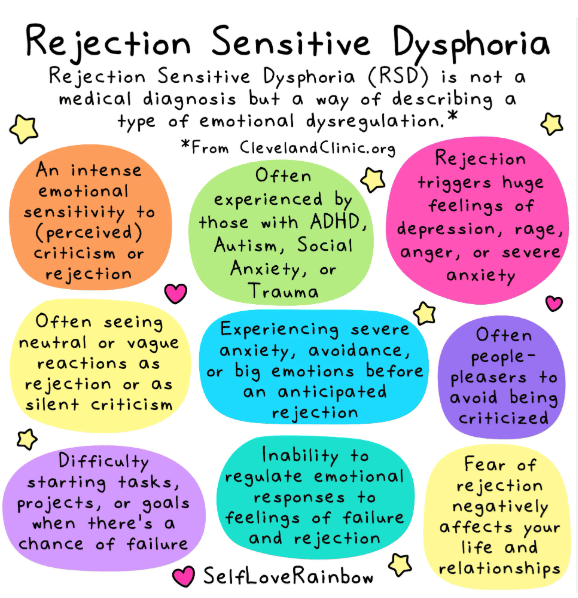
From clevelandclinic.org
Is there a link between RSD and impostor syndrome?
-
There are meaningful overlaps. Impostor syndrome involves persistent self-doubt and a fear of being exposed as a fraud despite evidence of competence.
-
RSD can amplify or colour impostor feelings: when criticism triggers a torrent of self-judgment, it can resemble impostor thoughts. Conversely, someone with impostor syndrome might experience RSD-like distress in response to perceived failure or external judgment.
-
In short, they are distinct phenomena, but they can reinforce each other. Understanding both as part of a broader emotional landscape helps in choosing compassionate strategies rather than getting stuck in a loop.
Why do people suffer from RSD?
-
Evolution of sensitivity: For some, heightened sensitivity to social cues is adaptive in social learning and group integration. But in a world of mixed feedback, the same sensitivity can become painful.
-
Neurodivergent wiring: Many people with ADHD, autism, or other neurodivergent profiles report stronger emotional reactions and more intense perception of rejection or criticism.
-
Past experiences: Early experiences of rejection, ridicule, or inconsistent feedback can create a chronic pattern where rejection cues are interpreted as personal threats.
-
Self-criticism as a default: A harsh inner critic can magnify even minor feedback into a global assessment of worth.
Are neurodivergent people more likely to suffer from RSD?
-
There is evidence that several neurodivergent groups report more frequent or intense RSD experiences, particularly those with ADHD and autism. This is not universal, but the overlap is meaningful:
-
ADHD: Emotion regulation challenges and heightened reactivity can accompany RSD.
-
Autism: Sensory and social processing differences can intensify the perception of social feedback as negative.
-
Other neurodivergent profiles: Some individuals report RSD-like experiences in relation to social expectations and feedback.
-
-
It’s important to emphasize: RSD is a human experience that can affect anyone, but neurodivergent individuals may be more likely to encounter it, or experience it more intensely, due to underlying neurocognitive patterns.
How can people cope? Practical strategies
-
Grounding and emotion labeling:
-
Name the emotion: “I feel overwhelmed and hurt by this feedback.”
-
Ground yourself: notice five things you see, four you hear, three you feel, etc., to reset the nervous system.
-
-
Slow down the reaction:
-
Practice a short pause before replying to feedback or criticism.
-
Use a delaying phrase: “Let me reflect on this for a moment and get back to you.”
-
-
Reframe the feedback:
-
Separate the critique from your self-worth. Feedback is about actions or outcomes, not your value as a person.
-
Ask clarifying questions to reduce ambiguity and prevent imagined worst-cases.
-
-
Self-compassion routines:
-
Melt away self-judgment with a brief self-compassion exercise: acknowledge pain, remind yourself you’re human, offer yourself a kind thought.
-
Create a personal “soothing toolkit” (breathing, a short walk, a favorite playlist, a comforting ritual).
-
-
Build supportive environments:
-
Seek safe spaces with trusted people who provide specific, descriptive feedback and balanced praise.
-
Set boundaries around feedback—when, where, and how you receive it.
-
-
Cognitive strategies:
-
Challenge all-or-nothing thoughts: “If I got criticized, it means I’m a failure” → “This is painful, and it doesn’t define my entire ability.”
-
Reframe impostor thoughts as clues for growth: “What can I learn from this feedback?”
-
-
Practical habits to reduce frequency/intensity:
-
Consistent routines for sleep, nutrition, exercise, and screen time supporting emotional regulation.
-
Regular breaks and micro-rests to prevent overwhelm in demanding days.
-
-
When needed, professional support:
-
A therapist trained in emotion regulation or neurodiversity can offer tailored strategies.
-
Coaching for ADHD or autism can provide concrete tools for managing reactions to feedback and building confidence.
-
A few mindful reminders
-
You are not alone. Many people—neurodivergent and neurotypical alike—experience RSD and impostor feelings at different times.
-
RSD is not a flaw or weakness. It’s a signal about how sensitive and attuned you are to social information and how your nervous system processes feedback.
-
Small, consistent habits often beat heroic, one-off efforts. Gentle, steady practice compounds over time.
Practical next steps
-
Try a 2-minute RSD reset when you notice the first sting of rejection: name the emotion, take three slow breaths, and write down one concrete step you can take.
-
Start a simple “RSD journal” to track triggers, intensity, and what helped. Over time, you’ll spot patterns and effective strategies.
-
Consider a quick consultation with a therapist or counselor who understands neurodiversity and emotion regulation. Many offer sliding scales or telehealth options.
Thank you for reading, I really hope this information help. If you would like to discuss further please do not hesitate to get in touch info@sanitashub.co.uk
With warmth and support,
Christina
Booking a Mental Health Wellbeing Course with Sanitas Hub
Mental Health Consultancy in the Workplace
For further inquiries, company group training or mental health consultancy please do not hesitate to get in touch at info@sanitashub.co.uk